Canada has no income tax treaty with Uruguay. For a Canadian retiree, that one fact matters more than the beaches, the steak or the residency rules. Before your CPP, OAS, workplace pension and RRIF payments leave Canada, 25% of each comes off the top. No treaty rate brings it down, and if both countries decide you're theirs, nothing settles it.
The rest of the picture is very good. Uruguay is a small democracy of about 3.5 million people that changes governments without drama. It runs on US dollars as comfortably as pesos and grants permanent residency without asking you to buy anything. Global Affairs Canada gives it the lowest advisory level, "take normal security precautions". And Uruguay doesn't tax foreign pensions, so a Canadian retiree pays its tax authority essentially nothing on them.
Here's the catch: Uruguay is not cheap. Outside rent, Montevideo costs about what Toronto does. And the famous tax holiday was rewritten on January 1, 2026, closing the cheap routes in and the permanent 7% rate. If your plan rests on a 2023 YouTube video, it's out of date.
The Cost of Living Case (Such As It Is)
The rent gap is real. Most other gaps aren't. These are crowd-sourced Numbeo prices from early October 2026, converted at about UYU 28 per Canadian dollar (BCU and Bank of Canada rates, August–October 2026).
| Category | Montevideo | Toronto | Notes |
|---|---|---|---|
| 1-bed apartment, centre | ~C$1,005/mo (UYU 28,350) | ~C$2,260/mo | The big saving |
| 1-bed apartment, outside centre | ~C$815/mo | ~C$2,020/mo | |
| 3-bed apartment, centre | ~C$1,655/mo | ~C$3,840/mo | |
| Inexpensive restaurant meal | ~C$21 | ~C$25 | Close to parity |
| Mid-range dinner for two | ~C$98 | ~C$110 | |
| Cappuccino | ~C$6.50 | ~C$5.70 | Uruguay costs more |
| Monthly transit pass | ~C$107 | ~C$156 | |
| Utilities (85 m² apartment) | ~C$270 | ~C$172 | Electricity is expensive |
| Single person, monthly, excluding rent | ~C$1,410 | ~C$1,435 | Effectively the same |
Read that last row twice. Prices carry a 22% basic VAT rate and a small market's import costs, and the peso has held up against the loonie. The saving is rent, and it shrinks in the neighbourhoods Canadians want. Two-bedroom listings in Pocitos and Punta Carretas mostly ask UYU 37,000–45,000 a month (C$1,300–1,600). On top of that come gastos comunes, the building fees, at roughly UYU 4,000–13,000 (C$140–460).
Punta del Este costs more and swings with the season. Numbeo's central one-bedroom is about UYU 44,000 (C$1,570), though that rests on only 28 contributors. December-to-March rentals are priced for Argentine and Brazilian holidaymakers. Colonia del Sacramento is the value play: InfoCasas puts the median one-bedroom at about US$516 (C$735).
A couple who own outright or rent outside the prime barrios can live well. A couple planning to live on CPP and OAS alone will find Uruguay tighter than Colombia or Mexico.
Climate: Four Seasons, Including One You'll Complain About
Uruguay is temperate and humid, with rain spread evenly through the year and no dry season.
| Region | Summer (January) | Winter (July) | Character |
|---|---|---|---|
| Montevideo and the south coast | Avg high ~28°C, low ~18°C | Avg high ~14°C, low ~6°C | Humid (about 75% average relative humidity, around 80% in winter), windy, damp winters |
| Punta del Este and the Atlantic coast | Similar, with sea breezes | Similar; very quiet off-season | Resort towns that half-empty after March |
| Colonia and the western River Plate | Similar to Montevideo | Similar to Montevideo | Riverside, calmer water |
| North (Salto, Paysandú, Artigas) | Avg highs 32–33°C; records above 42°C | Avg high ~18°C, low ~7°C; occasional frost | Hotter summers, drier winters |
Winter is the trade-off. Six degrees sounds easy to anyone from Winnipeg. Six degrees at 80% humidity, with a pampero wind coming off the Argentine plains, is something else. Expats routinely say heating is what they underestimated: many homes rely on split units or stoves, not central heat, and electricity is expensive. Ask about heating before you sign a winter lease.
Healthcare: FONASA, Mutualistas and the Gap Nobody Mentions
Uruguayan healthcare is good. The planning problem is getting into it.
FONASA, the national health fund, is paid for by contributions to BPS, Uruguay's social security agency. Workers, Uruguayan retirees and their families pick a mutualista, a non-profit health cooperative, and FONASA pays the fee. A Canadian living on Canadian income pays nothing into BPS, so FONASA isn't open to you, and people outside the formal workforce can't buy in voluntarily. That leaves three options:
| Option | What it is | Typical monthly cost | Catch |
|---|---|---|---|
| ASSE (public) | State hospitals and clinics | Income-based cuota; free below a threshold | Longer waits; quality varies |
| Mutualista, individual member | The same cooperatives FONASA members use | e.g. Asociación Española adult fee UYU 3,869 (~C$137), July 2026 | Screening, age-based waiting periods, co-pays |
| Premium private plan | Hospital Británico, MP, Summum and others | UYU 5,000–12,000+ (C$180–425+) | Strict entry ages |
Age decides most of it. Mutualistas can screen individual applicants with an exam or a sworn health declaration. They can also impose a carencia, a waiting period before pre-existing conditions are covered. One expat guide reports roughly six months at ages 51–65, ten at 66–75 and fifteen at 76–90. Emergency care usually starts on day one. Premium plans are stricter. Hospital Británico's reported maximum entry age is 60, and plans built for seniors charge an entry premium. A September 2026 comparison priced Mautone Pass at UYU 13,850 a month (~C$490) for ages 70–75, plus a one-time entry fee of about UYU 233,000 (~C$8,275). Cantegril Master, for those 75 and older, was UYU 21,304 a month (~C$755), with an entry premium of about US$11,000 (~C$15,700) at age 75. Co-pays are modest: Asociación Española listed a GP visit at UYU 190 (~C$7) and a specialist at UYU 479 (~C$17). Many households also pay a monthly fee to a private mobile emergency service (UCM, SUAT, SEMM and others). The big providers don't publish their prices, so ask for a written quote.
The gap. Provincial plans cover temporary absences, not emigrants. Ontario, for example, keeps OHIP running abroad only if Ontario stays your primary home, and even then pays at most C$50 a day for emergency outpatient care and C$200–400 for an inpatient day. Most Canadian travel policies require valid provincial coverage, so when your province drops you, your travel insurance can go with it. Meanwhile, you can't join a mutualista until you're in Uruguay with a residency file open, and only then does the carencia clock start. Buy an international expat policy that begins before you leave Canada; these cost several hundred US dollars a month. Keep it until your mutualista's waiting periods have run out. With a serious pre-existing condition, price this first; it can decide whether Uruguay works at all.
Where Canadians Settle
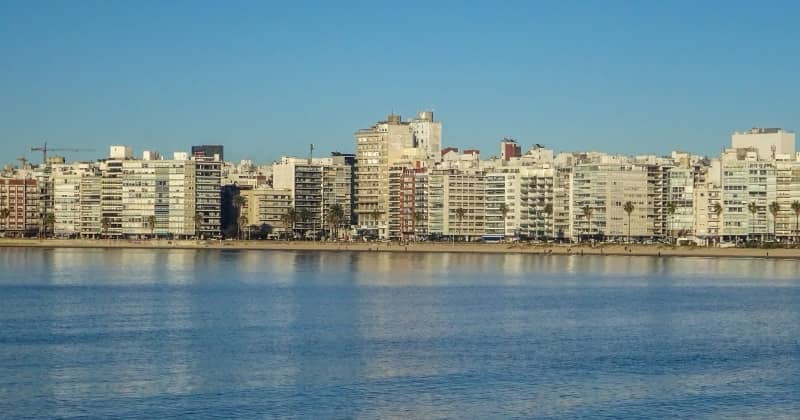
Montevideo is where most foreigners land, and its long riverside rambla is the city's front porch. Canadians cluster in Pocitos and Punta Carretas: walkable, near the water, and the priciest apartment rents in the city. Carrasco, by the airport, is leafier and suits families who want a house. The Ciudad Vieja has the architecture and the city's sharpest crime warnings.
Punta del Este, with La Barra and José Ignacio, is South America's Hamptons from December to March and a resort town on mute in July. Rent through a full winter before you buy. Colonia del Sacramento is a UNESCO-listed colonial town a short ferry ride from Buenos Aires. It's cheaper and calm, but serious medical care means a drive of a couple of hours to Montevideo. The Costa de Oro (Atlántida, Piriápolis and the beach towns east of the capital) is where many retirees end up after a year of Montevideo rents.
Expat Life for Canadians
The community is small. The 2023 census counted about 108,000 foreign-born residents, about 3.4% of everyone it reached. About 57,000 of them arrived between 2012 and 2023, more than double the arrivals the 2011 census found for the decade before, led by Venezuelans, Argentines and Cubans. Only 1,151 of those recent arrivals were born in the US; INE's published table puts Canadians under "other". You won't find a Canadian bar. You will find an English-speaking scene in Montevideo and Punta del Este, mostly American, Argentine and European, organized through WhatsApp groups.
Language. Spanish, in the Rioplatense accent of Buenos Aires. English is common among Montevideo professionals and in Punta's tourist trade. It's thin at the migration office, at your mutualista and anywhere in the interior. The residency rules tell non-Spanish speakers to bring an interpreter to their hearing, which tells you the level of service to expect.
Banking. Uruguay is heavily dollarized. Property is priced in US dollars and USD accounts are ordinary. Private banks (Itaú, Santander, BBVA) generally want a Uruguayan cédula, proof of address and income, sometimes a reference letter from your Canadian bank, and a source-of-funds review. The state bank, BROU, does take non-resident foreigners, but requires new non-resident clients to place at least US$5,000 (~C$7,100) on term deposit for 181 days. The practical order is: arrive, file for residency, get your provisional cédula, then bank. Wires from Canada go by SWIFT, usually into a USD account. Expect an outgoing fee, a correspondent-bank deduction and an incoming fee, and keep the paper trail for big transfers like a property purchase.
Flights home. There's no nonstop service between Canada and Uruguay. The usual routes are Copa via Panama City (from Toronto and Montreal), or connections through São Paulo, Bogotá, Lima or Santiago, plus a seasonal Miami flight on American. Air Canada's Buenos Aires service runs via São Paulo. It's two flights and a long day at minimum, which matters if you have aging parents in Canada.
Safety. Global Affairs Canada rates Uruguay "take normal security precautions". Montevideo is the exception, at "exercise a high degree of caution" because of crime. The specific warnings: petty theft, thieves on motorcycles grabbing phones and bags, and care at night on 18 de Julio, in the Ciudad Vieja, around Plaza Independencia and near the port. A dozen outer neighbourhoods, including Casavalle, Cerro and Marconi, are flagged by name. Houses are burgled more often than apartments, and pickpockets follow the summer crowds to Punta del Este and Colonia. That's typical for a South American capital, and it's why many Canadians choose a building with a doorman.
Getting Residency: Uruguay's Unusually Direct Path
Canadians can visit visa-free for 90 days and extend once inside. To stay, you apply to the Dirección Nacional de Migración (DNM). What sets Uruguay apart is that you can apply directly for permanent residency. You don't need temporary status first, and there's no investment or deposit.
| Pathway | Who it's for | Financial test | Duration | Path to citizenship? |
|---|---|---|---|---|
| Residencia legal permanente | Retirees, people on their own income, anyone staying | "Sufficient" stable income by notarized certificate; no fixed figure | Permanent | Yes, after 3 or 5 years |
| Residencia temporaria | Specific purposes (work contract, study) | Tied to the purpose | 180 days–2 years, renewable | Only if converted |
| Digital nomad permit | Remote workers for foreign employers | Sworn declaration of means | 6 months + one 6-month extension | No |
The Retiree Route, in Detail
The threshold. Uruguay has no pensionado visa with a published minimum. The rules ask for income "sufficient for maintenance" and leave the number to the DNM. Practitioners use about US$1,500 a month (~C$2,140) as the working benchmark. That figure actually comes from the retiree benefit law described below. Treat it as a floor for one person.
Which Canadian income counts. Any income that's stable and documented counts, including CPP, OAS, a defined-benefit pension and scheduled RRIF payments. A foreign retiree proves it with a notarized certificate covering status, income and how the money reaches Uruguay. A Uruguayan escribano (notary) prepares it from your Service Canada statements, your pension administrator's letter, RRIF payment confirmations and bank records. The DNM cares about what lands after the 25% Canadian withholding, so show both figures.
Documents.
- A valid passport.
- A national-scope criminal record check from Canada and from anywhere you lived six months or more in the past five years. Provincial and municipal checks are explicitly refused, so you need a fingerprint-based RCMP certified check.
- An apostille on each Canadian document. Canada joined the Apostille Convention on January 11, 2024. Global Affairs Canada apostilles federal documents, including the RCMP check. Alberta, BC, Ontario, Quebec and Saskatchewan apostille their own birth and marriage certificates; GAC handles the rest.
- A sworn Spanish translation by a Uruguayan traductor público.
- A marriage certificate issued within the past year, if your spouse is applying with you.
- A Uruguayan carné de salud and vaccination certificate from a Ministry of Public Health–licensed provider. You get these after you arrive.
Fees. The application fee is 557.30 UI (about UYU 3,700, or C$130). The certificate needed for your cédula is 55.70 UI (~C$13). Translation, notary and RCMP costs will easily exceed both.
Timeline and presence. You apply online, pay, upload documents and get an appointment to attend in person with originals. Arrive more than ten minutes late and you lose both the slot and the fee. Once you've filed, you can get a provisional cédula as a resident en trámite, which opens bank accounts and mutualista doors. The DNM publishes no processing time. Lawyers report hearings about three months after filing and decisions three to four months later, so budget six to twelve months. They also advise against leaving for more than six months while the file is open. Once you're approved, there's no annual minimum stay. But under Article 47 of the Migration Law, the government may cancel permanent residency after more than three years' absence.
The retiree benefit (Law 16.340) is often confused with residency. It's actually a customs break. Foreign retirees with permanent residency can import household goods and one vehicle duty-free; the vehicle can't be sold for four years. You need US$1,500 a month in foreign income, plus either a home worth at least US$100,000 (~C$143,000) held for ten years, or US$100,000 of Uruguayan government bonds held at BROU for ten years. Worth it if you're shipping a container.
From Residency to Citizenship
Article 75 of the Constitution grants ciudadanía legal to foreigners of good conduct. You need three years of habitual residence with a family established in Uruguay, or five years without one. You also need capital, property, a profession or a trade in the country. The Corte Electoral decides after an interview in Spanish, traditionally with two witnesses who've known you for the whole period. You keep your Canadian citizenship. Practitioners say the clock starts at arrival with intent to settle, and that you should live there most of each year, because the Corte checks migration records. Legal citizens can vote three years after receiving their carta de ciudadanía.
Here's the peculiarly Uruguayan catch. Under the long-standing official reading of the Constitution, legal citizens are citizens but not nationals. Their passports have listed their birth country in the nationality field, and some border officials abroad have refused them. In April 2025, Uruguay changed the passport to show "URY" for everyone and drop place of birth. Germany and France then refused the new passports, and Uruguay reverted on August 1, 2025. On October 9, 2026, the government announced a bill declaring legal citizens to be Uruguayan nationals. It's headed to Parliament and faces opposition.
The Spanish Passport Long Game, and Why It Mostly Doesn't Work
Spain's two-year naturalization route covers Uruguayans by birth, not legal citizens, so a naturalized Uruguayan should assume Spain's standard ten years; our Spain guide explains the rule. Children born in Uruguay do qualify for the two-year route.
Uruguay's Tax System
Uruguay is mostly territorial. It taxes income earned in Uruguay, plus a specific list of foreign income. Foreign pensions aren't on the list.
The Residency Test
You're tax-resident for a calendar year if any one of these applies:
- You spend more than 183 days in Uruguay. Absences of up to 30 consecutive days still count as present, unless you prove tax residence elsewhere.
- Your centre of vital interests is in Uruguay. This is presumed if your spouse and dependent minor children live there.
- Your main activity is in Uruguay: you earn more there than in any other country. This doesn't apply if your income is purely passive.
- You have economic interests above set thresholds, unless you prove tax residence elsewhere. The thresholds are real estate over 15 million UI (~C$3.5 million); real estate over 3.5 million UI (~C$830,000) bought since July 2020 plus at least 60 days' presence; or large business investments.
The tax year is the calendar year, and we found no split-year provision. Arrive in March and stay, and expect to be resident for that whole year. Canada, by contrast, treats your departure year as part-resident.
The missing tie-breaker. In a treaty country, a tie-breaker clause decides who gets you when both countries claim you as resident. Here nothing does. If you keep a home, a spouse or strong ties in Canada, the CRA can treat you as resident whatever Uruguay thinks. Cutting your ties cleanly matters more here than in Spain or Portugal, so run the tax residency checker before you go.
Leaving Canada? Let's get it right the first time.
The free tools get you most of the way. For the irreversible decisions, book a 45-minute call and we'll walk through your situation.
What Uruguay Taxes, and What It Doesn't
Uruguay's personal income tax (IRPF) taxes Uruguayan employment income at rates up to 36%. Uruguayan pensions pay a separate tax, the IASS. Foreign pensions pay neither. The IASS law excludes pensions arising from contributions to foreign social security institutions. In a 2019 ruling (Consulta 6214) on a German pension, the tax authority (DGI) held that such a pension owes neither IASS nor IRPF, and it relied on domestic law, not the treaty with Germany. The 2026 reforms widened the foreign income IRPF reaches, but left pensions out.
What IRPF does tax is foreign capital income: foreign interest and dividends at a flat 12%. Since January 1, 2026, it also taxes foreign rents and capital gains on foreign assets. A foreign tax credit exists for tax paid abroad on the same income, but it comes with proof requirements (Decree 95/026). If a Uruguayan broker holds your foreign securities in custody, it withholds 8%, and you can elect to treat that withholding as final. If you hold assets directly at a foreign broker, you make semi-annual advance payments at 12% instead.
Here's how that maps onto a Canadian's accounts:
| Account / income | Canada (after you leave) | Uruguay (as a tax resident) |
|---|---|---|
| CPP / OAS | 25% withholding; no treaty relief | Not taxed: foreign social security pension (DGI ruling) |
| Private DB pension | 25% withholding | Not taxed as a foreign pension, on the best reading |
| Government employment pension | 25% withholding | Not taxed, on the same reasoning |
| RRIF payments | 25% withholding on every payment, minimum or not | Unsettled. Practitioners treat registered-plan withdrawals like pensions, but no DGI ruling covers a RRIF; a payment from a foreign financial institution could be argued as capital income at 12% |
| RRSP | Growth sheltered; 25% withholding on withdrawals | Growth not taxed in practice; the 2026 rules that attribute a foreign entity's income to anyone owning 5% or more haven't been tested on registered plans |
| TFSA | Tax-free in Canada; no contributions while non-resident (1% a month penalty) | No shelter. Interest and dividends taxed at 12%; gains too, from 2026 |
| Non-registered investments | 25% on dividends; arm's-length interest generally exempt | 12% on interest, dividends and (from 2026) gains, with a foreign tax credit |
For the two unsettled rows, a formal DGI ruling request (consulta) on your plan is worth its cost. For your first eleven years, the holiday below may make them moot.
The Tax Holiday After January 1, 2026
Since 2011, Uruguay has offered new residents a holiday on foreign investment income. The 2025–2029 Budget Law (Law 20.446) closed the old version on December 31, 2025, and replaced it with an "impatriate" regime.
| Resident 2020–2025 (grandfathered) | Resident from January 1, 2026 | |
|---|---|---|
| The choice | Year of arrival + 10 years with foreign investment income untaxed, or a permanent 7% rate instead of 12% | Year of arrival + 10 years untaxed (11 tax years); the 7% option is closed |
| How you qualify | Becoming resident, including via the cheaper real-estate-plus-60-days route | More than 183 days in Uruguay each year with no investment; or real estate over 12.5 million UI (~C$2.95 million) bought since September 1, 2025 (urban property in inland departments counts double); or 625,000 UI (~C$148,000) a year into qualifying funds |
| Covers | All foreign capital income, now including the newly taxed gains and rents | Foreign capital income, including the newly taxed gains and rents |
| Afterwards | 12% (or 7% for life) | 12%; or ~6% for five years with a big investment; or a fixed annual tax of 1.875 million UI (~C$443,000), or 1.25 million UI (~C$295,000) in years with more than 183 days in Uruguay, for up to 20 years |
For a typical retiree, the 183-day route is the one that matters. It's free, but you have to qualify every year. The regulation spells it out: miss 183 days and you lose the holiday for that year, while the eleven-year clock keeps running. You elect once, by sworn declaration to the DGI, and can't take it back. You can't use the regime if you were a Uruguayan tax resident in either of the two prior years, or if you used the old regime. The holiday's rules are in Decree 188/026 (August 10, 2026), amended by Decree 225/026 (September 16, 2026). The wider foreign-income rules, including the tax credit, the 8% withholding and the advance payments, are in Decree 95/026 (May 6, 2026) and DGI Resolution 1517/026 (June 29, 2026). Have a Uruguayan contador confirm the election procedure. The fixed option isn't aimed at you; it's aimed at Argentine families with nine-figure portfolios.
Wealth Tax and Foreign-Asset Reporting
Uruguay's net wealth tax reaches only assets located in Uruguay. In 2025, the first UYU 6,653,000 (~C$236,000) of net Uruguayan assets was exempt, doubled for a family unit, and residents paid 0.1% above that. Your Canadian accounts aren't in the base. A Montevideo apartment bought for cash might be.
There's no equivalent of Spain's Modelo 720, meaning no standalone return listing foreign assets. You report taxable foreign income on your IRPF return or through advance payments. Both countries take part in the OECD Common Reporting Standard, and they've had a tax information exchange agreement since 2014. Assume the DGI will see your Canadian accounts.
No Tax Treaty: What Canada Withholds
The Department of Finance's list of Canada's tax treaties doesn't include Uruguay at all: not in force, not signed, not under negotiation. The only bilateral tax agreement is the 2013 Tax Information Exchange Agreement, which shares information and reduces nothing.
So Canada's Part XIII default applies to everything: 25% of the gross on CPP, OAS, workplace pensions, RRIF payments (minimum or above), RRSP withdrawals, dividends and rents. Most of Canada's treaties cut the rate on periodic pensions, and some exempt CPP and OAS from Canadian withholding altogether. Uruguayan residents get none of that.
A Worked Example
Take a single retiree who has emigrated to Montevideo and spends more than 183 days a year there. The figures are illustrative, in CAD; OAS is the full October–December 2026 amount for ages 65–74:
| Income | Gross | Canadian withholding (25%) | Uruguayan tax | Net |
|---|---|---|---|---|
| CPP | $14,000 | $3,500 | $0 | $10,500 |
| OAS (full, at $762.50/month) | $9,150 | $2,287.50 | $0 | $6,862.50 |
| Former employer's DB pension | $30,000 | $7,500 | $0 | $22,500 |
| RRIF payments | $25,000 | $6,250 | $0 on the best reading (see table above) | $18,750 |
| Dividends, non-registered Canadian stocks | $6,000 | $1,500 | $0 under the holiday; otherwise 12% ($720) less a credit for Canadian tax, likely $0 | $4,500 |
| Total | $84,150 | $21,037.50 | ~$0 | $63,112.50 |
Uruguay takes nothing, and Canada takes a flat quarter. Section 217 is the lever. A non-resident can elect to file a Canadian return on CPP, OAS, pension and RRIF income and pay tax at graduated rates instead of the flat 25%. With modest income that's mostly pensions, it often produces a refund; with larger incomes it may not. To have payers withhold less for up to five years, file Form NR5 by October 1 or before the first payment. You then file a section 217 return each year by June 30; the CRA won't process a late one. Dividends aren't eligible.
OAS has its own paperwork. Uruguay isn't on the CRA's list of countries whose residents are excused from the Old Age Security Return of Income (Form T1136). You file it every April 30, or your OAS stops in July. The recovery tax applies to net world income above C$93,454 for the 2025 tax year, so our retiree is clear of it.
The Canada–Uruguay Social Security Agreement
A social security agreement has been in force since January 1, 2002. It covers CPP and OAS on Canada's side, and Uruguay's old-age, disability and survivor pensions on the other.
It matters mainly for OAS abroad. If you live outside Canada, you need 20 years of Canadian residence after age 18 for OAS to keep paying indefinitely. Below that, it stops about six months after you leave. Under the agreement, periods credited under Uruguay's pension system count as Canadian residence, both for qualifying and for meeting that 20-year minimum. The catch: you only earn Uruguayan credits by contributing to Uruguay's system, and a retiree living on Canadian income doesn't. For CPP, Uruguayan credited periods after age 18 can fill a contribution shortfall. Each country pays only for its own periods. The QPP isn't covered, so Quebec contributors deal with Retraite Québec. If your residence in Canada after 18 is under 20 years, run the OAS eligibility calculator before you leave.
The Financial Considerations Most Canadians Overlook
Departure tax. When you emigrate, the CRA deems you to have sold most capital property at fair market value: non-registered portfolios, private company shares, foreign real estate. Canadian real estate, including your home, and registered accounts are excluded. Uruguay's new tax on foreign gains raises the stakes, because we found no rule that resets your cost to market value on arrival. Once any holiday ends, a gain that partly accrued in Canada could be taxed again in Uruguay when you sell, with no treaty to sort it out.
Ongoing Canadian income. Rent from Canadian property attracts 25% of the gross unless you elect under section 216. Dividends attract 25% with no relief.
Registered accounts. You can keep your RRSP, RRIF and TFSA, but you can't contribute to a TFSA as a non-resident, and its shelter means nothing in Uruguay. Any Home Buyers' Plan or Lifelong Learning Plan balance comes due when you leave. For wills, licences and PR cards, see estate planning for expats, driver's licence, passport and PR card and how to leave Canada. The ten costly mistakes guide covers brokerage accounts that restrict non-residents.
Planning Your Departure Properly
Asset review and optimization. Identify which assets trigger a deemed disposition, and whether to realize gains or losses first. Uruguay now taxes foreign gains, so holding or selling is a two-country question. Start months ahead.
Residency severance. With no tie-breaker, your Canadian status rests entirely on your ties. Sell or lease out the house, move your spouse, cancel your provincial health card and memberships. Half-leaving is the most expensive way to leave.
Uruguayan tax planning before arrival. Decide on the holiday before your first tax year closes, plan for 183 days every year, and decide where non-registered assets should sit: in Canada, with a Uruguayan custodian at 8%, or sold. Consider a DGI ruling request on your RRIF and pension.
Coordination between jurisdictions. With no treaty, there's no mutual agreement procedure and no tie-breaker, and double tax is avoided only by domestic credits. Canada's side is section 217, NR5 timing and the OASRI. Uruguay's side is the holiday election and IRPF advance payments. Someone has to look at both at once.
Run Your Own Numbers First
Cross-border advisers bill by the hour, and a no-treaty country generates more hours than most. Expatify is built for Canadians who want to understand the Canadian side of their numbers before they start writing those cheques. Every calculator is free, with no sign-up. They model Canadian tax only; none calculates Uruguayan tax yet.
| Free tool | What it does |
|---|---|
| Departure tax calculator | Estimates your deemed-disposition liability based on your actual assets |
| Expat income tax calculator | Models your Canadian tax after you leave; Uruguay isn't supported yet |
| Non-resident withholding calculator | Shows Canadian-side withholding only on pensions, dividends and rent (for Uruguay, the 25% default) |
| OAS eligibility calculator | Checks whether your OAS keeps paying abroad, given your years in Canada |
| Tax residency checker | Walks through the residential ties the CRA weighs when deciding whether you've actually left |
| Leaving-Canada checklist | Organizes the whole process by timeline, from twelve months out through post-departure, so nothing slips |
If you'd rather talk it through, you can also book a one-on-one call.
Making the Decision
Uruguay suits a particular Canadian: someone who values stability over bargains, can live with a damp winter, manages in Spanish, and wants permanent residency without buying their way in. For that person, a country that leaves foreign pensions alone and runs its institutions well is worth a great deal.
It suits that person less if they're counting on low prices, need care for a serious pre-existing condition, or assumed a treaty would trim their Canadian withholding. The arithmetic is fixed: Canada keeps a quarter of your pension income unless section 217 does better, and Uruguay keeps almost none of it. If you're also weighing Panama or Costa Rica, give the Canadian withholding side of the comparison as much attention as the visa side.
Either way, start with the part you control: what leaving Canada will cost, and how much of your income will actually arrive in Montevideo.
Ready to understand what leaving Canada would cost you? Start with the departure tax calculator and get a clear picture of your obligations before you make any decisions.
Related Resources:
- CRA: Leaving Canada (Emigrants)
- Department of Finance: Canada–Uruguay Tax Information Exchange Agreement (no income tax treaty exists)
- CRA: Electing under Section 217
- CRA: Old Age Security Return of Income Guide for Non-Residents
- Canada–Uruguay Social Security Agreement
- Uruguay DNM: Residencia Legal Permanente
- Uruguay DGI (Dirección General Impositiva)
- Law 20.446 (2025–2029 Budget Law) on IMPO
- Global Affairs Canada: Uruguay travel advice
Free Tools & Calculators:
- Canadian Departure Tax Calculator
- Expat Income Tax Calculator
- Non-Resident Withholding Tax Calculator
- OAS Eligibility Calculator
- Tax Residency Checker
- Leaving-Canada Checklist
This content is for educational purposes and reflects information current as of October 2026. Tax rates, visa requirements, and government programs change — Uruguay's 2026 tax reforms were new and largely untested at the time of writing. Verify details with the relevant authorities before acting. Individual circumstances vary, and cross-border tax situations benefit from professional guidance.