
Here's a sentence that stops most future expats mid-plan: the day you become a non-resident of Canada, the CRA deems you to have sold nearly everything you own — and taxes you on the gains, even though you didn't sell a thing and no money changed hands.
It's called the departure tax, and it isn't a penalty, a punishment, or an exit fee for disloyalty. It's a deemed disposition under section 128.1(4) of the Income Tax Act, and the logic behind it is almost fair: Canada taxed you on your worldwide income while you lived here, so it wants its share of the gains that built up on your watch — settled now, before you and your portfolio disappear into another country's tax system.
Almost fair. Because in practice, the departure tax lands on people who never saw it coming: the retiree whose "boring" index funds quietly doubled, the couple who assumed their house covered everything, the professional who found out about Form T1161 eighteen months too late and got fined for a form that owed no tax at all.
Here's how the whole machine works: what's deemed sold, what's spared, what the bill actually looks like, and the elections that let you postpone paying it — sometimes for decades.
First things first: this only happens if you actually leave
The departure tax is triggered by one event: the day you cease to be a tax resident of Canada. Not the day your flight leaves, not the day you get your new visa — the day your residential ties shift enough that Canada no longer considers you a resident.
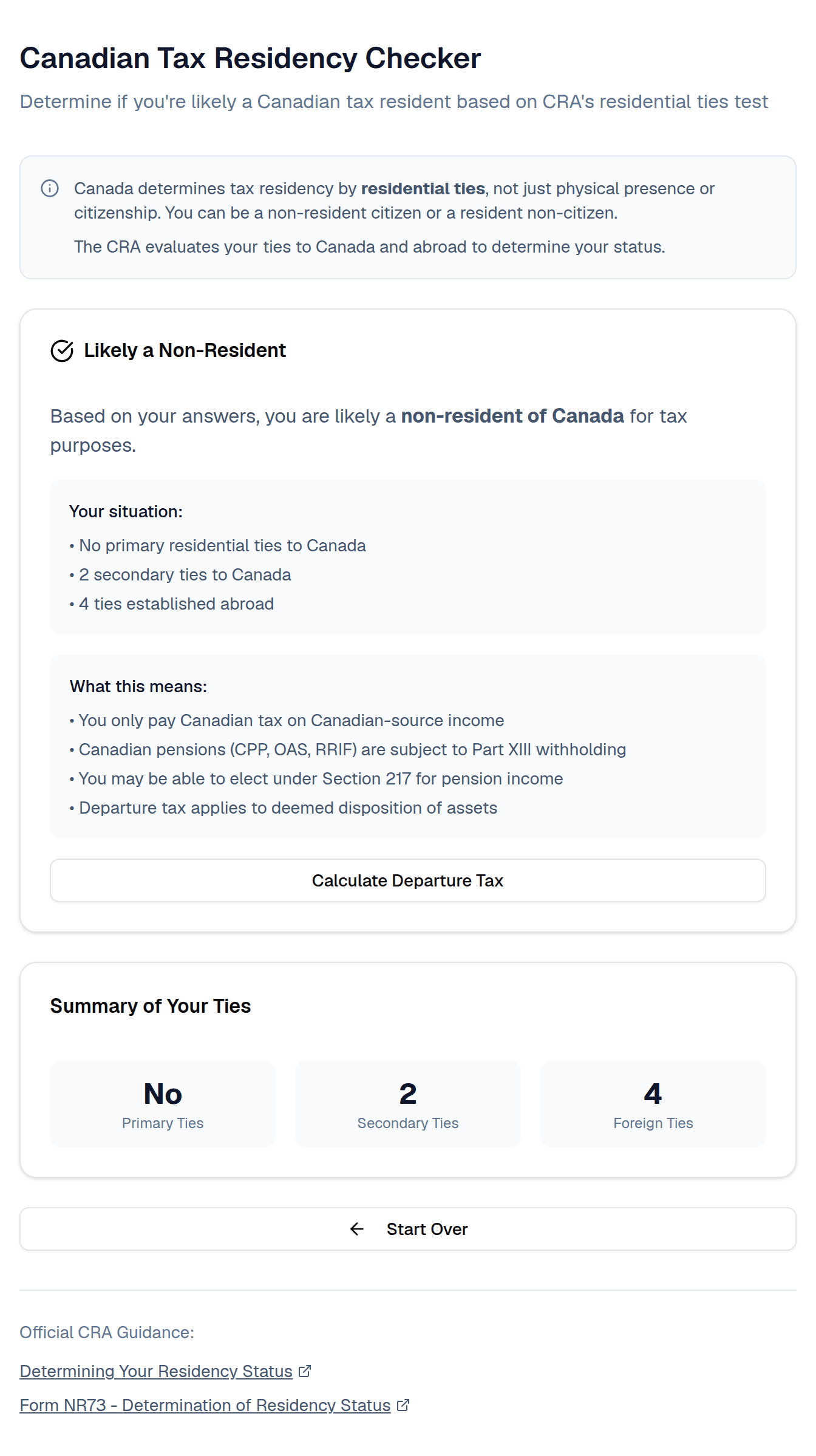
That's a facts-and-circumstances test, not a checkbox. The CRA looks at primary ties (a home available to you in Canada, a spouse or dependants still here) and secondary ties (bank accounts, a provincial driver's licence, provincial health coverage, memberships, a car in your brother's garage). Keep a primary tie and you'll usually still be a resident — still taxed on worldwide income, and no departure tax yet, because you haven't departed. The exception: if your new country also treats you as a resident and has a tax treaty with Canada, the treaty's tie-breaker can make you a deemed non-resident, and the same departure rules apply.
Our tax residency checker walks the CRA's ties test in about a minute:
Two things to note before moving on:
- Your departure date matters enormously. The CRA usually treats you as a non-resident from the latest of three dates: the day you leave, the day your spouse or common-law partner and dependants leave, and the day you become a resident of your new country. That date sets the valuation date for every deemed disposition, splits your final tax return into a resident part and a non-resident part, and starts the clock on non-resident withholding for your pensions and RRIFs. Document it — lease signed abroad, ties severed, family moved — like you might one day have to prove it. Because you might.
- Form NR73 is optional. The CRA's residency questionnaire is for people who want its view on their status. What comes back is an opinion based on what you wrote, not a ruling, and the form hands the CRA a detailed inventory of your ties. You don't need it to emigrate: your departure date goes on page 1 of your final return.
What the CRA pretends you sold (and what it doesn't)
On your departure date, you're deemed to have disposed of most property you own at fair market value and instantly re-acquired it at that same value. Any accrued gain becomes taxable on your final resident return. The list of what's in and what's out is where the real planning lives.
Deemed sold on departure
- Non-registered investments — stocks, ETFs, mutual funds in taxable accounts. This is the big one for most people.
- Foreign real estate — the condo in Portugal counts, even though it's already abroad.
- Private business interests — shares of your corporation, partnership interests.
- Crypto and other capital property — collectibles, precious metals, and most other property with an accrued gain.
Not deemed sold on departure
- Canadian real estate. Real property in Canada is taxable Canadian property — Canada can tax it whenever you actually sell, no matter where you live, so the Act leaves it out of the deemed disposition (s.128.1(4)(b)(i)) and taxes it on the actual sale. Your home, rental property and cottage cross the border with you untouched (for now).
- RRSPs and RRIFs. Registered plans aren't deemed disposed. They stay intact and get taxed later through non-resident withholding on withdrawals — a different regime, with its own elections.
- TFSAs and FHSAs. No deemed disposition, and Canada keeps treating TFSA income and withdrawals as tax-free. Three warnings, though. The CRA says you can't contribute to a TFSA while you're a non-resident; if you do, the Act charges 1% of the contribution for every month it stays in. An FHSA's tax-free home-purchase withdrawal requires you to be a Canadian resident. And your new country may not recognize either wrapper, so it may tax the account like any other investment account.
- Your home in Canada. It's Canadian real property, so it's out for the same reason as the cottage. When you do sell, the principal residence exemption shelters the gain for the years it was your principal residence while you lived in Canada. (Whether to sell before or after you leave is its own decision — more below.) A home abroad is foreign real estate, so it's on the deemed-sold list.
- CPP, OAS, and pension rights. Pension plans, annuities, and CPP and OAS rights are "excluded rights or interests" under s.128.1(10), so they're not deemed disposed. Nothing to deem.
One more escape hatch worth knowing: short-term residents — in Canada 60 months or less during the 10 years before departure — are exempt on property they owned when they last became residents, and on property they inherited after arriving. If you came for a five-year work stint and are heading home, the departure tax may barely touch you.
The math: your gains get stacked on top of your income
The deemed gains aren't taxed at some special flat rate. They're capital gains on your final resident return: 50% of the gain is included in income, and that taxable half gets stacked on top of everything else you earned in the departure year — salary, business income, the works. Which means the same portfolio costs more to exit in a year you also earned a full salary than in a year you didn't. Timing is a lever.
Here's a concrete scenario in our departure tax calculator: an Ontario resident with $60,000 of other income in the departure year, a non-registered portfolio worth $450,000 that cost $250,000, a TFSA, and a principal residence:
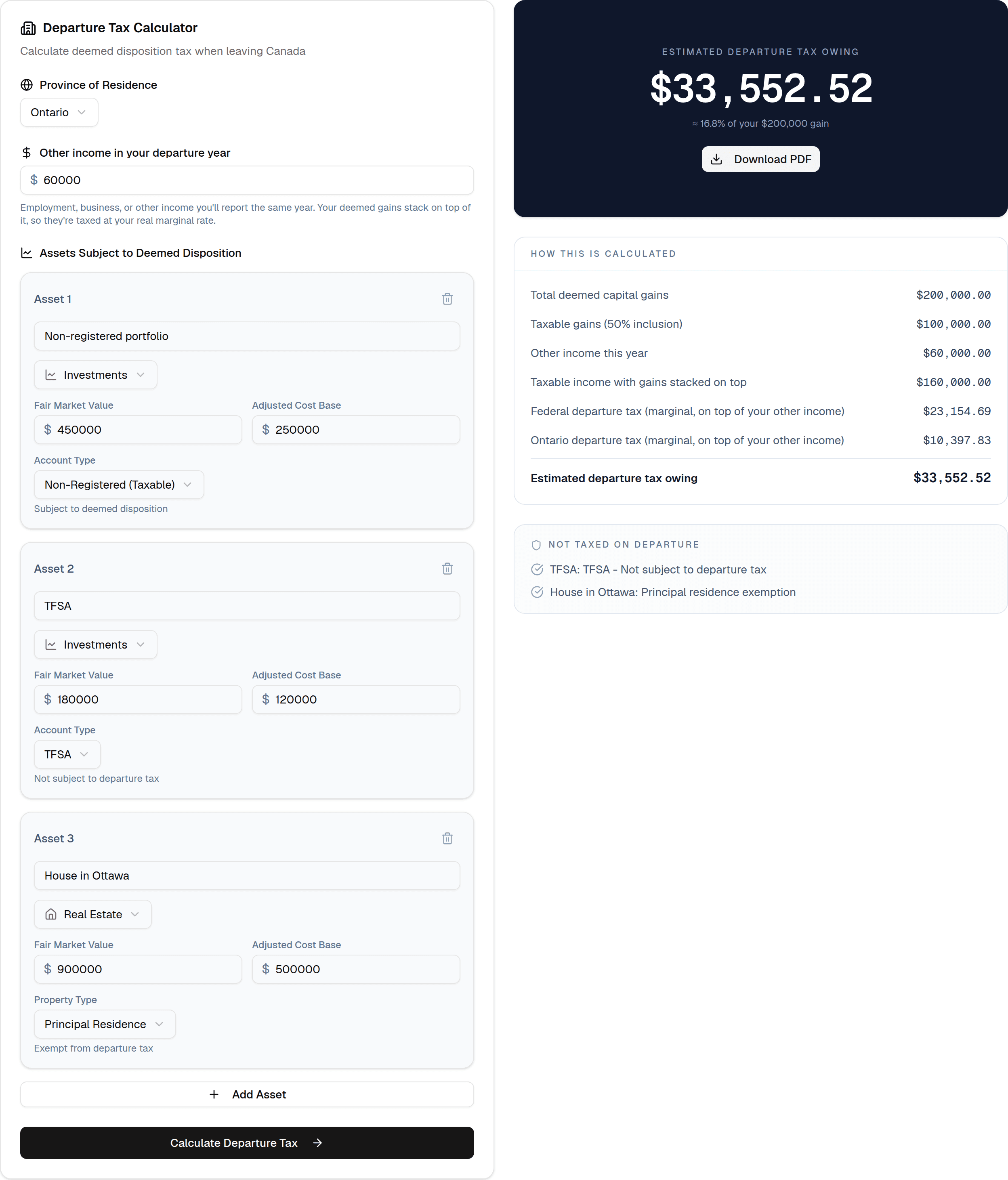
The $200,000 paper gain on the portfolio produces a departure tax bill of roughly $33,000 — about 17 cents per dollar of gain (the exact figure moves with each year's brackets; at 2026 rates the calculator gives $33,162) — while the TFSA and the house pass through untouched. No cash was received. The bill is real anyway.
The calculator handles every province and territory, stacks the gains on your other income so you see the true marginal cost, and shows the whole computation line by line. Run your own numbers before you pick a departure date — a January departure and a December departure can be thousands of dollars apart.
The paperwork: three forms, one famous trap
The departure tax lives on your final resident tax return, due April 30 of the year after you leave. Three forms do the work:
- Form T1161 — List of Properties by an Emigrant of Canada. If the property you own when you leave is worth more than $25,000 in total, you must file this inventory. Canadian cash and bank deposits, registered plans and pension rights, and personal-use items worth under $10,000 each don't count. Canadian real estate does, even though it isn't deemed sold. Here's the trap: T1161 is required even if you owe zero departure tax, and even if you don't otherwise have to file a return. It's an information form, and the late-filing penalty is $25 a day, with a $100 minimum and a $2,500 maximum — assessed cheerfully on people whose actual departure tax was nil. It's the easiest departure-tax mistake to make.
- Form T1243 — Deemed Disposition of Property by an Emigrant of Canada. The actual calculation: each deemed-disposed asset, its fair market value on departure day, its adjusted cost base, and the resulting gain. This is why you want valuations dated to your departure date — brokerage statements, an appraisal for the foreign property, a professional valuation for private company shares. Reconstructing fair market value two years later is expensive guesswork.
- Form T1244 — the deferral election. The quiet hero of the whole regime, which deserves its own section.
The election that defers the bill, interest-free
Owing $33,000 on gains you haven't realized is exactly as painful as it sounds — the deemed disposition creates a tax bill but no cash to pay it with. Parliament knew, so the Act contains a remarkable fix: elect on Form T1244 (s.220(4.5)) and you can defer paying the departure tax until you actually sell the property, whatever the amount. No payments, and — this is the remarkable part — no interest, however long the deferral runs. Sell the shares twelve years from now, pay the departure tax then, and the CRA charges you nothing for the wait.
The mechanics:
- File T1244 by April 30 of the year after you leave, electing to defer the tax on the deemed disposition.
- Security is only needed above a threshold. If the deferred federal tax is $16,500 or less ($13,777.50 for former Quebec residents), the Act treats the CRA as already holding adequate security (s.220(4.51)). Above that, you must give the CRA adequate security, arranged by that same April 30, and the CRA may also want security for the provincial or territorial share. In the example above, the federal share alone is about $22,900, so security would be needed. Contact the CRA early; it decides what it accepts.
- The deferral has no end date. Each asset's deferred tax comes due by April 30 of the year after you actually sell it, or are otherwise treated as disposing of it — on death, for example. If you move back to Canada, the CRA may collect it then, unless the unwind election below reduces or erases it.
And the companion rule for the changed-my-mind crowd: if you return to Canada while still owning the property, you can elect to unwind the deemed disposition on it (s.128.1(6)), reducing or eliminating the departure tax and freeing any security you posted. The election is due by your filing date for the year you come back. The departure tax is designed to tax leavers on what they take, not to punish people for trying life abroad and coming home.
The house question: sell before you go, or after?
Your principal residence deserves its own decision, because the exemption doesn't travel well.
The principal residence exemption shelters the gain for the years the home was your principal residence — and a year generally only counts if you were resident in Canada during that year. Sell while you're still a resident and the gain is typically fully sheltered (the exemption formula's extra year usually covers a sale soon after departure too). Hold the house for years after you leave and the arithmetic shifts: the post-departure years aren't covered, so a growing slice of the eventual gain becomes taxable — and since Canadian real estate isn't deemed disposed at departure, that reckoning happens on the actual sale, under non-resident rules.
Selling as a non-resident is also simply more annoying. You must notify the CRA within 10 days of the sale, and pay or secure the estimated tax, to get a section 116 certificate of compliance. Until it's issued, the buyer can hold back 25% of the price (50% on certain types of property) to cover their own liability. Any overpayment comes back when you file your Canadian return for the year of sale — after months of your money sitting in trust.
None of this means "always sell before leaving" — a hot rental market, a possible return to Canada, or a plan to sell within a year of departure can all tip the other way. It means the house belongs in the departure plan, not in the "deal with it later" pile. (The same goes for your will and powers of attorney, which may not survive the move either.)
How to actually plan for this
Pulling it together, the departure tax playbook looks like this:
- Confirm you'll genuinely be a non-resident. Run the residency checker, sever the primary ties, and document your departure date. No non-residency, no departure — just worldwide taxation with extra steps.
- Inventory everything before you book flights. What's deemed disposed, what's exempt, what's sitting on a big accrued gain. This is also the moment to find your adjusted cost bases, while the records are still easy to reach.
- Ask your brokerage what happens to your account — before you decide to hold. Brokerages set their own rules for non-resident clients; some restrict accounts to selling only ("liquidate only") or close them, and that operational reality can settle the sell-versus-hold question before the tax math gets a vote. If you'll be forced to liquidate anyway, selling while you're still a resident — on your own timing — beats selling on a 30-day deadline from abroad.
- Run the numbers on timing. Gains stack on top of departure-year income, so leaving in a low-income year — or realizing some gains gradually in the years before departure, or harvesting losses against the deemed gains — can shrink the bill. Every full tax year between now and departure is another run up the graduated brackets. Our calculator makes the comparison a two-minute job.
- Get departure-day valuations. Statements, appraisals, a valuation for the business. Dated evidence now beats forensic reconstruction later.
- Decide on the deferral. If the bill is painful and the assets are keepers, T1244 postpones it interest-free. If the deferred federal tax tops $16,500, budget time to arrange security before April 30.
- File the forms. Final return by April 30, T1243 for the calculation, T1244 by the same date if you're deferring, and T1161 even if you owe nothing — that $2,500 penalty is the cheapest mistake to avoid in this entire process.
- Check the other side. Some countries give arriving residents a step-up in cost base to fair market value (so the gain Canada just taxed never gets taxed again); others don't, and the treaty fine print decides. This is the one step where a cross-border accountant earns their fee several times over.
Our leaving Canada checklist folds all of this into the broader departure sequence — banks, CRA notifications, health coverage, the lot.
Leaving Canada? Let's get it right the first time.
The free tools get you most of the way. For the irreversible decisions, book a 45-minute call and we'll walk through your situation.
The bottom line: The departure tax isn't a reason to stay, and for most people it isn't even the biggest number in the move — but it is the least forgiving surprise. The day you become a non-resident, Canada settles the tab on your paper gains: non-registered investments in, registered plans and Canadian real estate out, everything valued as of one specific day. The people who get hurt aren't the ones with big portfolios. They're the ones who found out at filing time — after the valuation date had passed, after the timing levers had expired, and occasionally $2,500 poorer for skipping a form that owed no tax at all. Find out before you leave. It's cheaper.